

Nurses

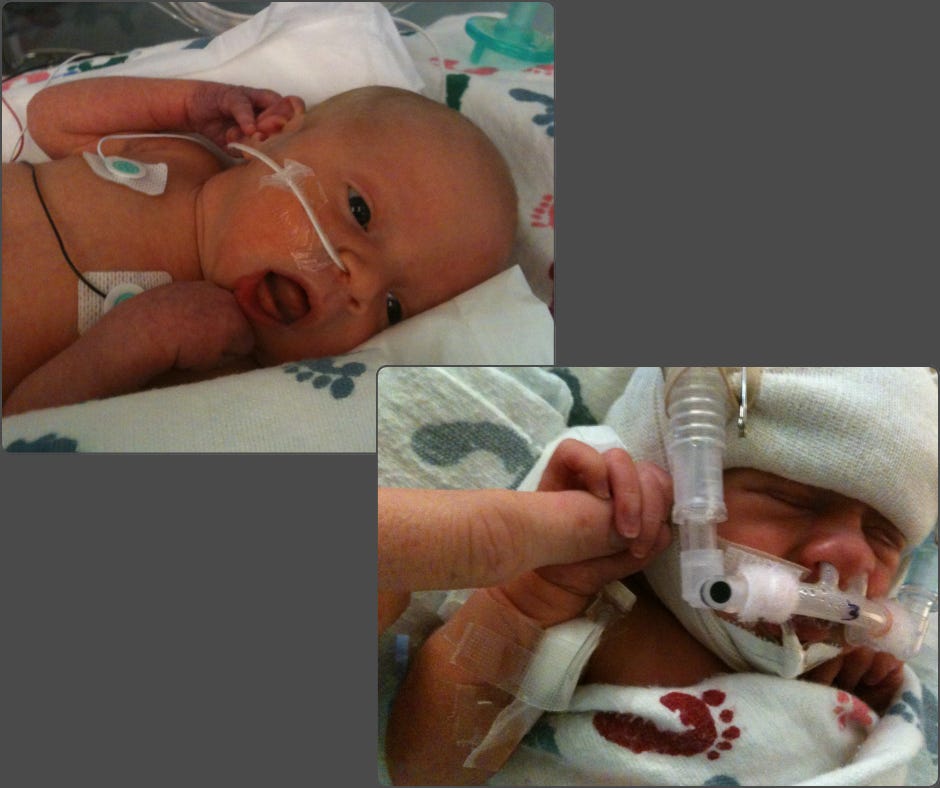
When our twins were born, things were bumpy. Luckily, we were in a wonderful hospital with an incredible team. The twins ended up in the Neonatal Intensive Care Unit (NICU). The NICU has special people and equipment that take care of recently born babies with complications.
Visiting the NICU is a grounding experience. All the caregivers are incredible people who work exceptionally hard in a very emotional environment. The smallest humans I have ever seen were in that room. Our twins were giants at almost five pounds and nearly six pounds.
On their first night in the NICU, I spent a lot of time in the room. I got to know several of the nurses well. The nurse primarily responsible for our kids had a great sense of humor, which is lucky for me because joking is my defense mechanism—perhaps just my default for most situations.
As exhaustion set in, everything seemed funnier. She was nearing the end of her shift, and the next shift was in the room, handing off charts and whatnot. As she moved to my daughter’s (twin A) bed, she accidentally referred to her as our son (twin B). I said, “Actually, that’s the girl. The boy came with more parts.” (I know it’s hacky and genetically inaccurate, but I was exhausted.)
The overnight nurse chuckled, and the oncoming nurse tore into me. “She has an extensive education, and she KNOWS the difference.” It caught me off guard. I was embarrassed, and then I got angry. It was just a joke. I know she can tell the difference.
It gnawed at me. Thankfully, I chose, “You are right. I am sorry.” I wasn’t sorry. I just was not going to pursue it. I later realized that we were playing two different games. Two different types of play. We had different rules with different stakes.
She wasn’t overreacting. She was responding appropriately within a framework I couldn’t see. I am not in her head, so I don’t know. I presume she was playing a game where the stakes were higher, where she had experienced routine dismissal of talents and capabilities. Where the need to defend fellow teammates was necessary and urgent. I was playing something different, something that required knowledge and trust of me. My rules were to ease out of my bigger emotions with smaller pressure releases.
Neither of us was wrong. Our views of the moment were not aligned. We weren’t clashing over facts, we were navigating different games—different realities. If someone is playing with higher stakes, I might see their intensity as offense instead of defense. Similarly, I can’t get away with jokes if I assume a level of trust I haven’t earned.
Do I assume my intentions are obvious to others? Can I choose compassion over winning? Will I understand what you believe is at stake?
Be curious, be kind, be whole, do good things.
The assumption of my intentions to others is a great question! Especially in tense situations or larger group settings. My sense of humor is dry, so I have to be extra careful. And I have to reciprocate this assumption… thanks for sharing!